

I've been tracking AgentExchange trends since the launch in March 2025, and the numbers tell a pretty interesting story about where Salesforce AI is headed. When this marketplace first dropped, I wasn't sure if it would just be a collection of half-baked ideas or actual tools we could use in production. But after six months, it's clear that this isn't just another AppExchange clone-it's a library of modular parts that actually help us build agents faster.
Breaking down the six-month AgentExchange trends
Look, the growth has been massive. We started with about 55 listings in March, and by October, that number jumped to 122. That is a 121% increase in just half a year. But it's not just about the number of apps. The number of developers has doubled too. What I like about these AgentExchange trends is that the "apps-per-developer" ratio stayed around 1.1 or 1.2. That tells me we're seeing a lot of different people contributing unique ideas rather than one or two companies flooding the zone with low-quality filler.
The timeline followed a pattern I've seen with other Salesforce releases. March and April were all about experimentation. People were just trying to see what would stick. Then, around May to July, things slowed down for a bit of cleanup. Salesforce actually retagged and removed some listings to keep the quality high. By the time we hit the pre-Dreamforce rush in September, the marketplace really matured. We're now seeing a steady stream of solid, partner-backed components.
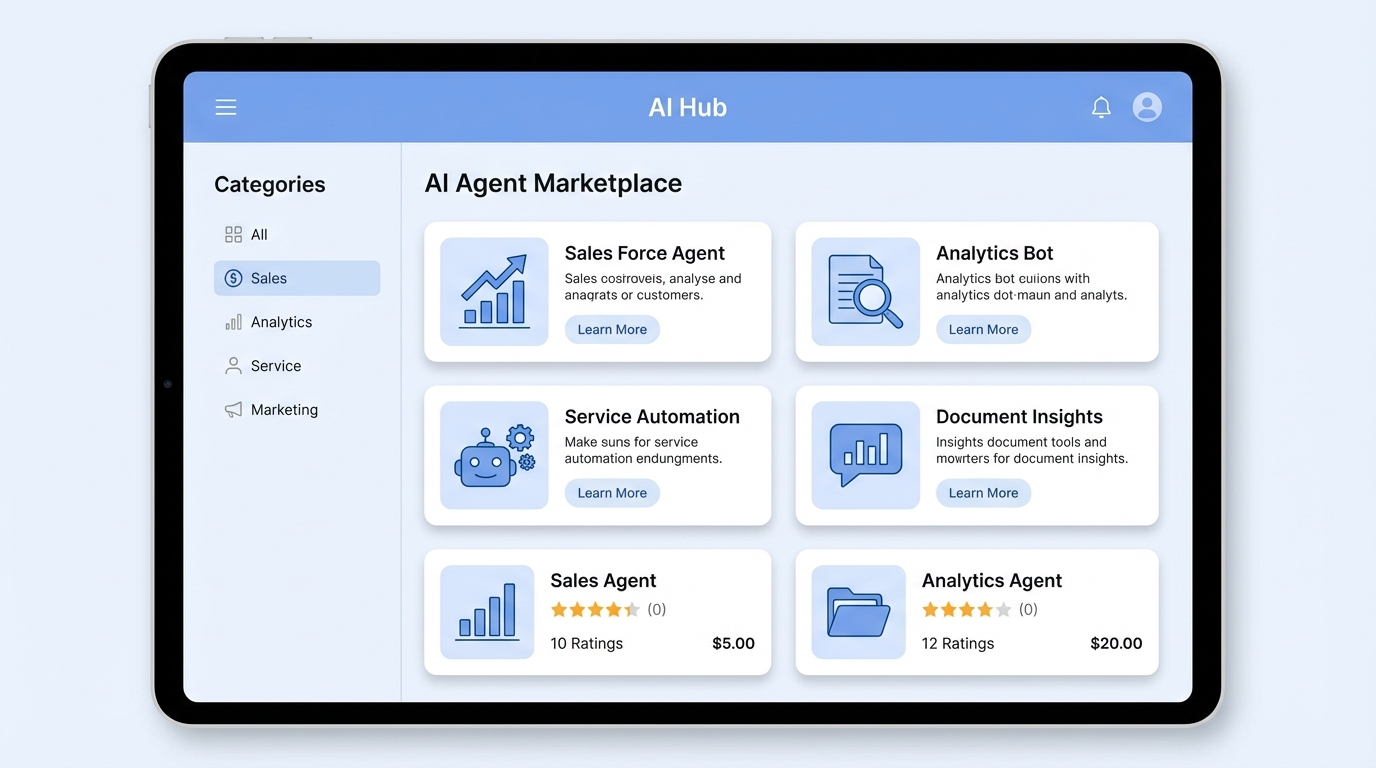
A professional marketplace interface showing a grid of organized AI agent listings and category filters in a clean dashboard view.
How Sales and Analytics dominate AgentExchange trends
So, where is the actual momentum? If you look at AgentExchange trends by category, Sales is the clear winner. It grew to 47 listings by September. It makes sense because sales teams are usually the first ones to ask for AI help with things like lead research or email drafting. But the real surprise for me was Analytics. It tripled in size mid-year. We went from 4 listings to 12, which shows that teams are looking for agents that can actually explain data, not just show it on a dashboard.
- Sales: Still the king with 47 listings.
- Productivity: Hit 18 listings and then leveled off.
- Analytics: The fastest grower, tripling its footprint.
- Commerce: A late bloomer, but starting to show up with 4 listings.
I've seen some solid 8 Practical Agentforce Use Cases for Salesforce Developers that really show how these building blocks fit together. Instead of building a whole agent from scratch, you're grabbing a prompt here and an action there. It's much more efficient than the old way of doing things.
The publishers leading the way
It's also worth looking at who is actually building this stuff. As of October, Breadwinner Integrations, Salesforce Labs, and Bullhorn are the most active. They each have about four listings. But here's the thing-16 new publishers joined the party recently. That's a good sign for the ecosystem. It means it's not just the "big guys" playing in this space anymore. If you are just getting started with Agentforce setup and deployment, these pre-built components can save you a ton of time on your first few projects.
In my experience, the best way to handle these new components is to treat them like any other managed package-test them in a sandbox first. Don't just assume a prompt will work perfectly with your specific data without some tweaking.
Practical ways to use these AgentExchange trends
So what does this actually mean for your day-to-day work? It means you don't have to be an AI researcher to get Agentforce running. You can pull a conversational prompt for Service Cloud to help with case triage, or grab an action to automate record updates in a Flow. Now, I've noticed that some people get tripped up by the "experimental" tags. My advice? Stick to the components from established publishers if you're putting this in front of users. Save the prototypes for your own R&D time.
One thing most teams get wrong is trying to do too much at once. They want a "God-agent" that does everything. Don't do that. Start small. Pick one specific prompt or action from the marketplace, deploy it, and see how it performs. You can always add more later once you've got the hang of how these components interact with your data.
Key Takeaways: AgentExchange trends at a glance
- Rapid Growth: Listings more than doubled in six months, hitting 122 apps.
- Sales Focus: Nearly 40% of the marketplace is focused on Sales use cases.
- Quality Control: Salesforce is actively cleaning up the marketplace, so the "stable" listings are getting better.
- Modular Build: The shift is toward small, reusable actions rather than giant, monolithic apps.
The bottom line? AgentExchange has turned into a reliable spot for finding real-world AI tools. It's moved past the "cool demo" phase and into the "let's get to work" phase. If you haven't checked it out lately, you should. The landscape is changing fast, and keeping up with these AgentExchange trends is the only way to make sure you aren't rebuilding the wheel every time a stakeholder asks for a new AI feature. Grab a few components, run them through their paces in a sandbox, and see how much time they actually save you.




Leave a Comment