
Addressing the AI Governance Gap in Autonomous Agents
Modern agents are no longer confined to predictable application boundaries. They dynamically invoke APIs, retrieve enterprise context, orchestrate complex workflows across platforms, and interact with diverse data sources in real-time. As these systems become more autonomous, organizations face a critical challenge: a loss of visibility into the data influencing outcomes, the systems involved in execution, and the consistent enforcement of governance policies.
Traditional data governance platforms, built for deterministic pipelines and stable architectures, struggle to accommodate the fluid, runtime-dependent execution paths of agentic systems. This creates a significant governance gap, hindering enterprise observability.
Introducing Agent Fabric Context Catalog
Salesforce is integrating its Agent Fabric with Informatica's Enterprise Cloud Data Governance & Catalog (CDGC) to form the Agent Fabric Context Catalog. This solution acts as a unified governance control plane for AI services and data assets, delivering end-to-end visibility across agents, MCP (Multi-Cloud Platform) infrastructure, APIs, agent execution traces, and enterprise data systems.
Deterministic Linkage: Bridging APIs and Datasets
A key challenge is establishing accurate lineage between APIs and the underlying datasets they access. Traditional APIs expose contracts, not necessarily downstream data bindings, and agentic systems construct execution paths dynamically at runtime, preventing pre-declared bindings.
Most governance tools rely on inferential methods like fuzzy name matching or semantic inference. However, agents and integrations governed by MuleSoft expose a strong signal: their runtime configuration declares data source bindings, providing observed, not inferred, lineage.
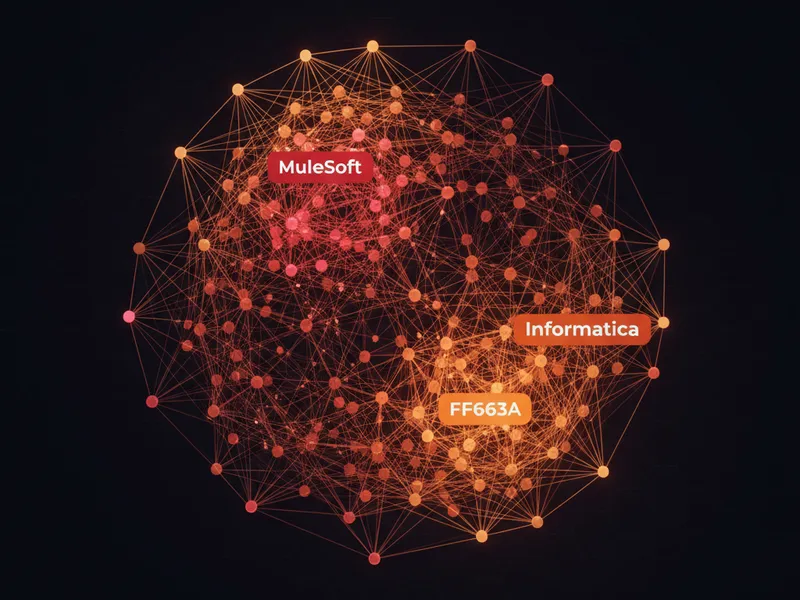
Agent Fabric catalogs agents and MCP servers. MuleSoft tracks runtime activity across APIs and infrastructure. Informatica provides dataset metadata, policies, and data quality metrics. By joining these on shared identifiers, a lineage graph can be constructed from agent execution to the enterprise data source:
Agents → MCP server → APIs → Datasets
Reconstructing Execution Paths with Gateway-Level Tracing
While lineage identifies potential data touchpoints, tracing reveals actual interactions for a specific call. MuleSoft Omni Gateway can inject trace identifiers into transactions as they traverse a workflow (e.g., Agent Broker → MCP server → MuleSoft API → Snowflake datasets cataloged in Informatica). These identifiers enable the reconstruction of execution paths across disparate platforms.
This reconstructability enables several operational capabilities:
- Identifying datasets that influenced a specific agent response.
- Surfacing governance and data quality signals before a response is delivered.
- Quarantining sensitive agents and applying runtime policies selectively.
- Containing the impact of hallucinations or policy drifts.
Furthermore, this infrastructure aids agent discovery. Developers can search for certified agents, inspect governance metadata, review data quality scores, and verify existing trusted datasets before building new orchestration workflows, making governance a precondition for development.
Confidence-Based Lineage: Managing Inference
Not all relationships can be deterministically observed, especially with external APIs or agents operating outside the MuleSoft execution layer. The platform explicitly surfaces confidence ranges for inferred relationships. Edges derived from MuleSoft metadata are distinguished from those inferred through semantic similarity, which carry a confidence score. Consumers can filter lineage based on these confidence levels.
This transparency is crucial for enterprise trust. A governance system that claims certainty it cannot defend risks losing credibility with auditors. Differentiating between observed and inferred relationships maintains this credibility.
Human-in-the-Loop Validation
When confidence scores fall below a defined threshold, mappings are routed for human review. Reviewers can approve, reject, or correct inferred relationships. These corrections feedback into the system, improving future inference.
This validation workflow is not an end-stage quality gate but a continuous mechanism that strengthens lineage accuracy and creates an audit trail of observed, inferred, and human-verified relationships.
From Static Compliance to Continuous Runtime Governance
Autonomous agents evolve dynamically. Governance models built on static compliance checkpoints cannot keep pace. Agent Fabric is transitioning towards continuous runtime evaluation, monitoring for hallucination drift, policy compliance, runtime toxicity, governance violations, and behavioral changes over time.
What Trustworthy Enterprise AI Requires
Building AI agents is no longer the primary challenge; building trustworthy agents is. Trust hinges on visibility across the entire agent lifecycle: agents, MCP infrastructure, APIs, runtime execution paths, datasets, governance policies, and distributed observability.
By combining the orchestration and API visibility of Agent Fabric with the data governance depth of Informatica's CDGC, a single operational layer is created where lineage, explainability, and policy enforcement converge. As autonomous AI becomes core enterprise infrastructure, this governance visibility layer is paramount for establishing trust.
Key Takeaways
- Autonomous agents introduce a governance gap due to dynamic execution paths and fragmented observability.
- Agent Fabric Context Catalog unifies AI services and data asset governance by integrating Agent Fabric with Informatica CDGC.
- Deterministic linkage between APIs and datasets is established through MuleSoft runtime configuration, providing auditable lineage.
- Gateway-level tracing reconstructs agent execution paths across platforms, enabling granular control and visibility.
- Confidence-based lineage clearly distinguishes observed from inferred relationships, enhancing enterprise trust.
- Human-in-the-loop validation continuously improves inference accuracy.
- The shift is towards continuous runtime governance to keep pace with evolving autonomous agents.


Leave a Comment