
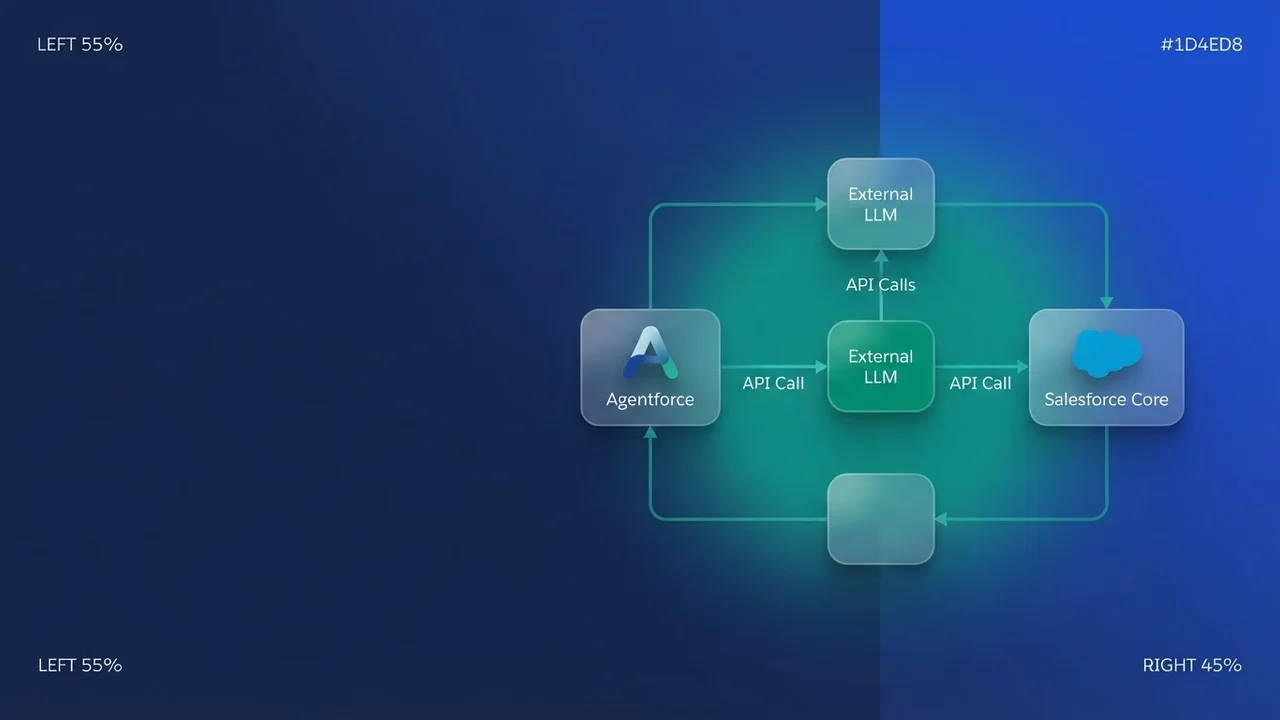

Architectural strategy: native vs. external AI
The choice between Salesforce's native Agentforce and an external LLM (Claude, or OpenAI's Codex) called through MuleSoft usually comes down to data gravity, security posture, and how much maintenance you are willing to own.
Native Agentforce implementation
Agentforce is designed for deep integration within the Salesforce ecosystem, and it runs through the Einstein Trust Layer. Grounding is automatic: it reaches Data Cloud and Salesforce metadata without a hand-built RAG (Retrieval-Augmented Generation) pipeline. Security is native, following Salesforce permission sets and object-level security. Orchestration stays low-code, wired into Flow and Apex through Agent Actions.
External LLM via MuleSoft
Calling an external LLM through MuleSoft buys flexibility for highly custom or model-specific requirements, such as using specific Claude 3.5 Sonnet features for advanced code generation. Callouts between MuleSoft and an external API add latency, so the asynchronous handling has to be deliberate. The security boundary becomes yours: you are responsible for masking PII before data leaves the Salesforce org. MuleSoft itself is another hop in the path, though it does centralize AI governance for the enterprise systems that sit outside Salesforce.
Implementation comparison
| Feature | Agentforce | External LLM (MuleSoft) |
|---|---|---|
| Data security | Native / Einstein Trust Layer | Manual / custom middleware |
| Grounding | Automated via Data Cloud | Custom RAG required |
| Extensibility | Apex and Flow Actions | REST/SOAP API interfaces |
| Maintenance | Low (platform managed) | High (requires API monitoring) |
When to use which
Use Agentforce when your primary goal is automating business processes within Salesforce. Cutting the custom code for data grounding and security makes it the better choice for CRM-heavy use cases.
Use an external LLM through MuleSoft when your AI strategy has to cover the whole enterprise rather than Salesforce alone, or when you need a specific model whose reasoning capabilities the Salesforce ecosystem does not currently support.

Leave a Comment