

If you're prepping for a technical round, you've probably realized that generic Salesforce developer interview questions are a thing of the past. Interviewers at places like Deloitte, Accenture, or even smaller product shops want to see how you think, not how well you can recite a textbook.
I've sat on both sides of the interview table. In my experience, the candidates who stand out aren't the ones who know every single method in the Apex documentation. They're the ones who can look at a messy business problem and explain why they'd choose a Queueable over a Batch job, or why a specific Flow might actually be a bad idea for performance. Let's look at what you actually need to know to handle these conversations like a pro.
Why scenario-based Salesforce developer interview questions matter
Look, anyone can memorize the definition of a governor limit. But can you explain how to fix a "Too many SOQL queries: 101" error in a legacy codebase? That's what people are looking for. When I first started out, I thought knowing the syntax was enough. It isn't. You need to understand the trade-offs. For example, knowing when to use Apex vs Flow is a massive part of the job today.
Most interviewers will throw a "what if" at you. "What if the client needs to process 10,000 records every hour?" or "What if we need to prevent duplicates without using standard duplicate rules?" Your job is to walk them through your logic. Don't just give the answer; show the work.
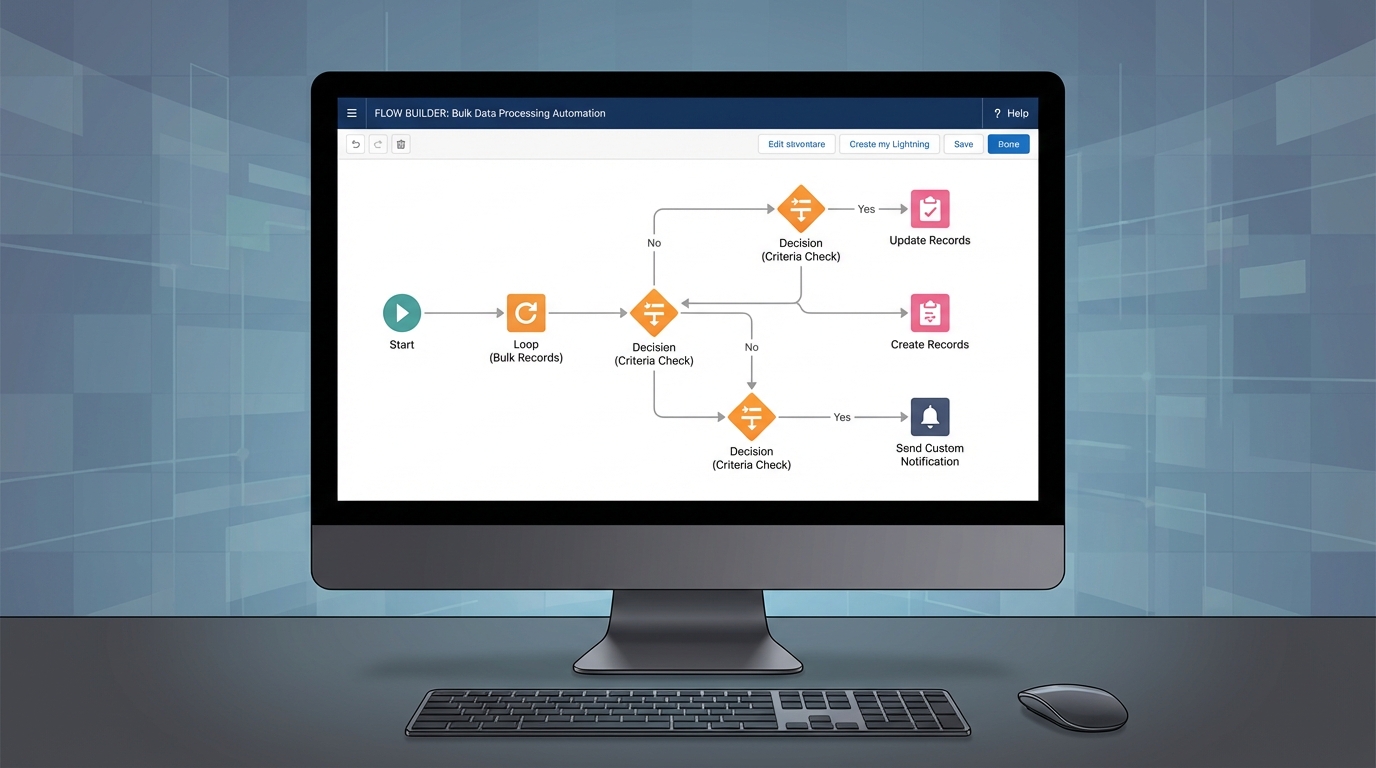
A realistic Salesforce Flow Builder canvas showing a complex architectural logic for processing large volumes of data.
Common Salesforce developer interview questions and patterns
Here's the thing: most Salesforce developer interview questions fall into a few specific buckets. If you master these patterns, you can answer almost anything they throw at you. It's about having a mental toolbox ready to go. Let's break down some of the most frequent scenarios I've seen in real interviews lately.
Handling record locking in high-volume orgs
One thing that trips people up is the UNABLE_TO_LOCK_ROW error. If two processes try to update the same record at the same time, one is going to fail. You'll often be asked how to handle this in code. The short answer? Use the FOR UPDATE keyword in your SOQL.
List<Account> myAccs = [
  SELECT Id, Name
  FROM Account
  WHERE Id IN :accIds
  FOR UPDATE
];

for (Account a : myAccs) {
    a.Rating = 'Hot';
}
update myAccs;
But here's a pro tip: don't just use it everywhere. It can slow things down if you aren't careful. I usually tell interviewers that I'd also wrap this in a try-catch block to handle the locking exception gracefully and maybe retry the logic later.
Finding duplicates with aggregate queries
Sometimes you can't use standard tools, and you've got to find duplicates manually. This is a classic test of your SOQL skills. Instead of looping through thousands of records (which is a terrible idea), use an aggregate query. It's much faster and stays well under your limits.
SELECT Email, COUNT(Id)
FROM Contact
WHERE Email != NULL
GROUP BY Email
HAVING COUNT(Id) > 1
Processing massive datasets
When you're dealing with more than 50,000 records, your standard trigger or controller isn't going to cut it. This is where Batch Apex comes in. But don't just say "I'll use a Batch." Explain how you'll manage asynchronous Apex limits by adjusting your scope size. If I'm doing heavy callouts, I might set my scope to 1 or 10. If it's simple field updates, I'll stick to 200.
The goal isn't just to get the code working. It's to make sure it doesn't break when the data volume hits a million records next month. Scalability is the difference between a junior and a senior dev.
How to prep for your next technical round
So how do you actually get ready for these Salesforce developer interview questions? It isn't about cramming 100 answers into your head the night before. It's about practicing the "why" behind the "how". Here is a quick checklist I use when I'm helping colleagues prepare:
- Pick 10 scenarios: Practice explaining them out loud. If you can't explain it simply, you don't understand it well enough yet.
- Focus on limits: Every answer should consider governor limits. It shows you respect the multi-tenant architecture.
- Security first: Always mention FLS (Field Level Security) and CRUD checks. Honestly, most teams get this wrong, so mentioning it makes you look like a superstar.
- Async vs Sync: Know exactly when to move a process to the background.
And don't be afraid to say "I don't know, but here is how I'd find out." I'd much rather hire someone who knows how to use the community and documentation than someone who makes up a wrong answer on the spot.
Key Takeaways
- Think in patterns: Don't memorize code; memorize the logic of when to use specific tools like Batch, Queueable, or Flow.
- Prioritize bulkification: Every answer involving triggers or DML must be bulk-safe. No exceptions.
- Explain the trade-offs: If you suggest a solution, mention one downside or one alternative you considered.
- Focus on the platform: Use Salesforce developer interview questions as a way to show you understand the "Salesforce way" of doing things, not just general Java or C# logic.
At the end of the day, these interviews are just conversations between two people trying to solve problems. If you can show that you're practical, aware of the platform's limits, and focused on building maintainable solutions, you're going to do just fine. Good luck out there!




Leave a Comment