


Agentforce adoption metrics and technical hurdles
Data readiness is the primary technical blocker holding Salesforce Agentforce adoption to roughly 6.3% across existing customers. When CRM records suffer from missing fields, inconsistent formatting, and schema drift, RAG retrieval and LLM prompt grounding fail directly. Overcoming this bottleneck requires developers to resolve contextual inaccuracies, prompt validation errors, and heavy ETL integration pipelines before agent features can function in production.
The reported figures are not flattering: roughly 9,500 paid deals against an existing base of 150,000 customers. That works out at around 6.3% adoption, not the 12% implied by a looser reading of 9.5k out of 150k.
Competitor numbers scale differently. Around 15 million paid seats out of roughly 500 million commercial users is a lower percentage with a far higher raw deployment volume, which points at the same friction showing up on both sides of the market.
The data readiness bottleneck
Everything points at data readiness as the primary technical blocker for getting AI and agent functionality deployed, including where Salesforce is putting its money. The Informatica investment was not a coincidence.
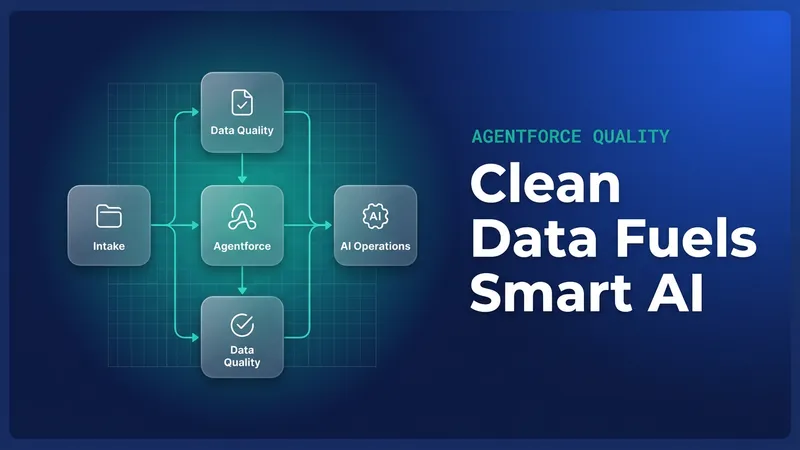
Agentforce features lean on contextual, high quality data going in, both for prompt generation and for the accuracy of what comes back. So the state of your CRM data structure decides the outcome. Incomplete records, inconsistent formatting, outdated relationship mappings, and schema drift each degrade Retrieval Augmented Generation (RAG) and large language model (LLM) grounding directly.
Three ways that lands on developers:
- Contextual inaccuracy. These models need clean, semantically rich context. SOQL queries run against poorly indexed or messy data give you unreliable output.
- Prompt engineering failure. Effective prompt construction assumes predictable data schemas. When the fields you inject for context are null or inconsistent, complex prompts fail validation or return nonsense.
- Integration complexity. Data preparation usually means real ETL or ELT pipelines outside the Salesforce instance, and then keeping them fresh enough for the agent to use. That is architectural overhead nobody budgeted for.
Deploying Agentforce in production: a developer query
If your team is past the pilot stage and running Agentforce in production, the data preparation effort tends to match or exceed the platform configuration effort. The questions worth putting to each other:
- Which ETL or data quality tools did you use to normalize data before activation?
- How long did remediation take, on average, per object critical to Agentforce functions?
- How do you manage schema evolution so it does not break existing Agentforce training sets or context retrieval?
Until the data infrastructure question is answered, meaningful ROI on high-cost generative AI features is not going to show up, whichever vendor you buy from.


Leave a Comment