Accelerating Release Velocity with Deterministic Automation
Salesforce engineering teams managing complex ecosystems like AI Cloud often face significant deployment latency introduced by manual release governance. The conventional process—relying on release managers to coordinate across disparate dashboards (SLO availability, PagerDuty configs, FIT results) via Slack—created human bottlenecks, often requiring hours or days to achieve production readiness sign-off.
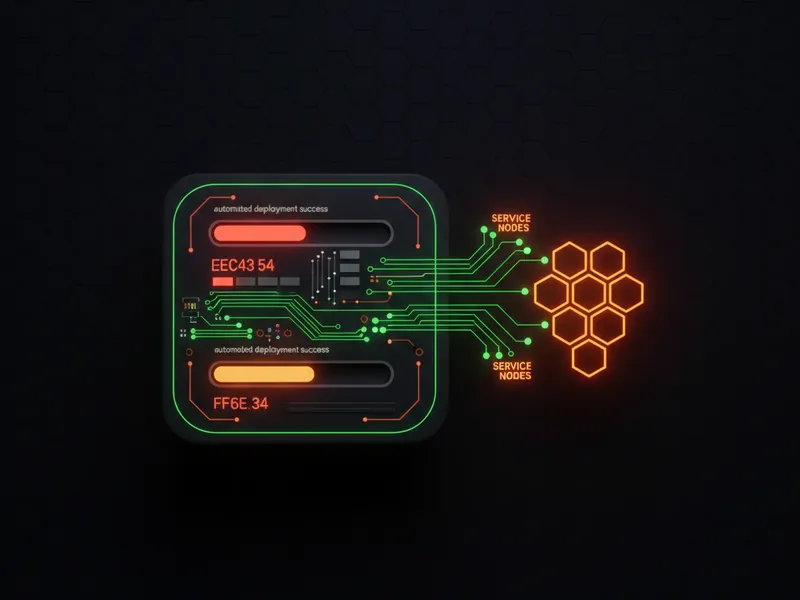
To resolve this constraint, the AI Cloud Infrastructure team developed Luminary, a centralized automation platform serving as a release control plane. This shift transforms release validation from a reactive, human-interpreted process into a proactive, programmatically enforced workflow, directly linking system health metrics to deployment permission.
Replacing Human-Gated Latency with Programmatic Enforcement
The primary bottleneck was the throughput limitation of service owners waiting for manual verification. The Luminary team engineered an automated approval engine to execute verification logic instantly.
This engine performs real-time validation by querying telemetry (e.g., Argus for availability), cross-referencing FIT results across service boundaries, and confirming escalation policies before promotion is granted. This reasoning layer runs within the workflow engine, eliminating queueing.
Previous State: Serialized, Human-Gated Process (Hours/Days)
New State: Self-Service Model governed by Luminary (Seconds)
Engineers now receive immediate approval the moment codified readiness thresholds are satisfied, ensuring release velocity scales with system health rather than reviewer capacity.
Automated Production Readiness via Dependency Validation
In deep, interconnected microservice architectures, a single service might report healthy while its upstream or downstream dependencies are failing. Manual cross-referencing across monitoring dashboards to establish ecosystem health was untenable.
Luminary embeds automated dependency validation directly into the promotion workflow. The system traverses the dependency graph, scrutinizing live availability signals and FIT results for every linked service.
Promotion halts unless all dependent services meet predefined readiness thresholds. This enforces production readiness as a collective property of the environment, mitigating operational risk as complexity increases.
Event-Driven Promotion State Transitions
Context switching and manual polling previously stalled the handoff between environments (e.g., Stage to Production). Engineers had to wait for a stage deployment to complete, context switch back to Slack/approval dashboards, and manually trigger the next step.
Luminary now integrates directly with execution event streams (e.g., FUN execution events). The platform monitors deployment transitions in real-time and automatically triggers the subsequent approval phase upon successful completion of the prior stage.
This event-driven logic manages all transitions (Stage -> Production, Production -> GIA), ensuring workflow momentum is maintained via telemetry rather than human observation.
Enhancing Traceability with Automated Artifact Generation
Manual Git release tagging introduced significant traceability gaps regarding which commits reached production and which execution ID was associated with an incident. Metadata was often incomplete or missing.
Luminary now automates artifact generation:
- Commit Aggregation: Gathers all commits since the last release.
- Structured Release Notes: Generates metadata-rich notes.
- Execution Reference: Attaches the specific deployment execution ID to the Git artifact (major, minor, or patch).
This programmatic creation ensures consistent, traceable artifacts, vital for audits and incident correlation. Furthermore, for regulated environments like GovCloud, Luminary validates required Change Cases and automatically generates and populates GUS work items for the GIA channel, standardizing high-stakes handoffs.
Centralized State Management for Service Diversity
Supporting over 100 services, each with potentially unique dependencies, SLO definitions, and testing criteria, necessitates a unified configuration source. Luminary utilizes a centralized Postgres state engine as the source of truth for service metadata, dependency maps, and policy definitions, pulling authoritative data from monitoring systems.
This state model manages both static service attributes and dynamic telemetry, allowing workflows to adapt without requiring engineers to manually update configuration per service during the approval process.
Decoupling Background Processing for Stability
Early implementations combined the Flask API server (handling Slack interaction) with background processing (telemetry synchronization, cron jobs). Increased automation load led to resource contention and stability issues.
The architecture was refactored by introducing Starfall, a Golang-based engine dedicated to heavy background operations, including database synchronization and scheduled tasks. This change decouples intensive data processing from the real-time Slack interaction layer. Postgres remains the centralized state backbone, while Starfall ensures data freshness asynchronously, maintaining responsiveness under high concurrent load.
Key Takeaways
- Latency Reduction: Automated, deterministic approval logic reduced release validation time from hours/days to seconds by eliminating human coordination delays.
- Risk Mitigation: Programmatic dependency validation ensures ecosystem health (across all linked services) is verified before promotion.
- Architecture Decoupling: Separating real-time workflow interaction (Slack API) from heavy background operations (Starfall/Golang) improved system stability and responsiveness.
- Traceability Enforcement: Automated Git tagging and artifact generation linked deployments directly to commits and execution IDs, solving manual metadata gaps.
- Scalability: Release velocity now scales proportionally to the underlying system health, not the availability of release managers.




Leave a Comment