

I get asked about the difference between SOAP vs REST all the time when we’re mapping out new integrations. It’s one of those fundamental debates that never seems to go away, especially in the Salesforce world where we’re often stuck between modern web apps and legacy back-office systems.
Look, both of these technologies help systems talk to each other, but they do it in very different ways. I’ve seen teams pick the wrong one just because it was the “newer” option, only to realize later that their security requirements actually demanded the older approach. So let’s talk about what actually happens on the ground when you’re building these.
The main differences in SOAP vs REST
The first thing you need to know is that SOAP is a strict protocol while REST is more of an architectural style. Think of SOAP like sending a formal letter through a certified courier service. There are rules for the envelope, rules for the stamp, and a specific way you have to write the address. If you mess up one tiny detail, the whole thing gets sent back.
REST is more like sending a quick text message. It’s flexible, lightweight, and uses the standard HTTP methods we already use every day, like GET and POST. It doesn’t care as much about the “envelope” as long as the message gets there. Most modern Salesforce API integration projects I work on these days lean toward REST because it’s just easier to handle in JavaScript or mobile apps.
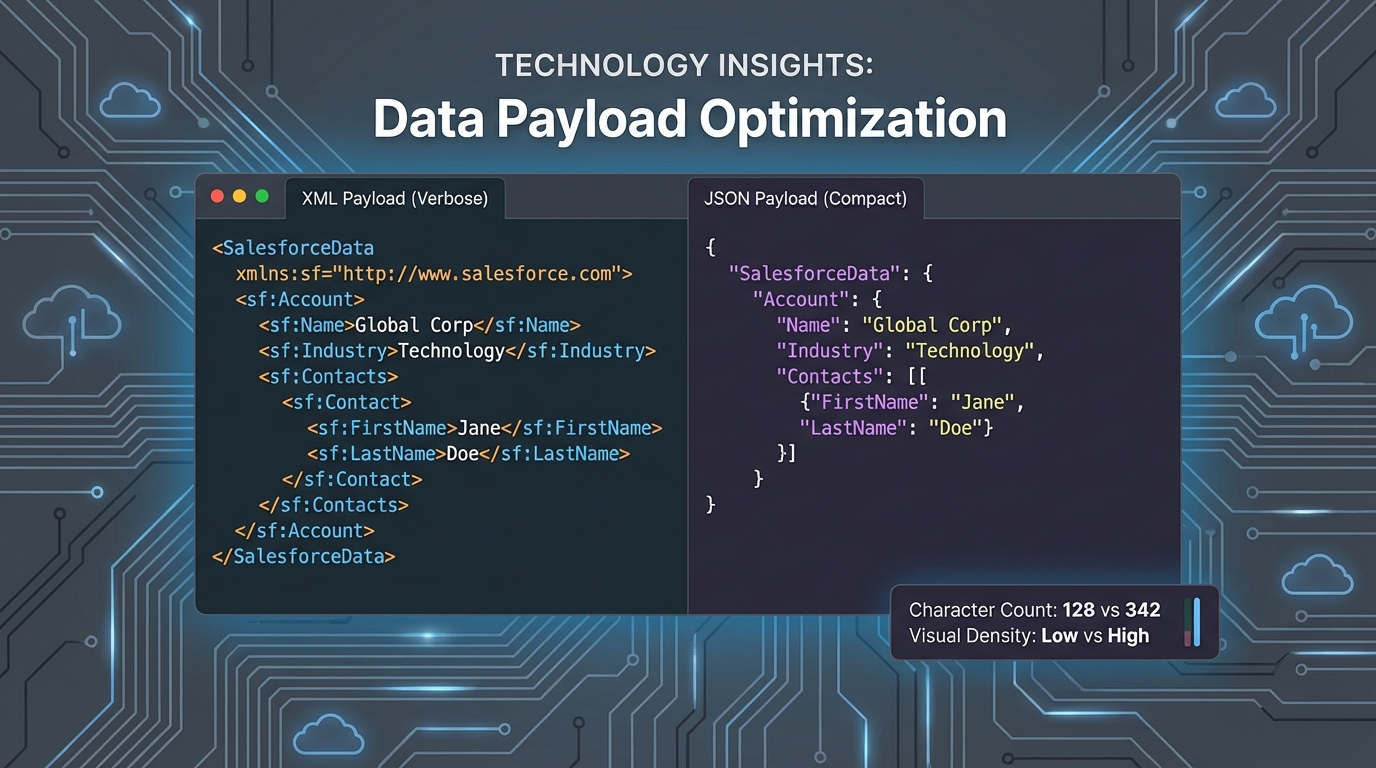
But here is where it gets interesting. SOAP only uses XML. If you’re a fan of JSON (which most of us are), you’re out of luck with SOAP. REST can do both, but almost everyone uses JSON because the payloads are smaller and faster to parse. When you’re dealing with thousands of records, those smaller payloads make a real difference in performance.
Technical deep dive: Security and Contracts
Now, let’s talk about the “contract.” In SOAP, you have a WSDL (Web Services Description Language). This is a file that tells the client exactly what the service can do. It’s very rigid, which is actually a good thing in enterprise environments. I’ve used it many times when I needed to make sure two systems stayed perfectly in sync without any guesswork. If you’re curious about how Salesforce handles this, you should check out the differences between the Enterprise vs Partner WSDL.
REST doesn’t require a contract, though we often use OpenAPI or Swagger to document things. It’s much more “go with the flow.” But what about security? This is a big one. SOAP has WS-Security built-in, which allows for message-level security. That means you can encrypt a specific piece of the data inside the message itself. REST usually relies on the transport layer (HTTPS) and tokens like the Salesforce JWT flow for authentication.
WSDLs are great until they aren’t. I’ve seen teams spend days just trying to get a client to generate correctly because of a minor XML namespace mismatch. REST is usually more forgiving, but you have to be more disciplined with your documentation.
Statefulness vs Statelessness
One thing that trips people up is state. REST is stateless by design. Every request from a client to a server must contain all the information needed to understand and process that request. This makes scaling a lot easier because any server can handle any request. SOAP can be stateful, which is sometimes necessary for complex, multi-step transactions in banking or old-school ERP systems. Honestly, most teams get this wrong and try to force state into REST, which usually leads to a mess.
Choosing between SOAP vs REST for your project
So how do you actually pick? In my experience, it usually comes down to what you’re connecting to. If you’re building a brand new mobile app or a web portal, REST is the winner 99 percent of the time. It’s faster, uses less bandwidth, and every developer knows how to work with it. And since it uses standard HTTP status codes (like 404 for not found or 500 for a server error), debugging is pretty straightforward.
But don’t write off SOAP just yet. If you’re working with a legacy financial system or a government database that requires extreme security and formal contracts, SOAP might be your only choice. It’s also better at handling “reliable messaging” where you need to guarantee that a message was received and processed in a specific order.
When to go with SOAP:
- You need formal contracts and strict data typing (WSDL).
- Your security requirements demand message-level encryption.
- You’re working with legacy enterprise systems that don’t speak REST.
When to go with REST:
- You’re building for mobile, web, or modern cloud apps.
- You want to use JSON and keep your payloads small.
- You need to scale quickly and want a stateless architecture.
Key Takeaways on SOAP vs REST
| Feature | SOAP | REST |
|---|---|---|
| Protocol/Style | Strict Protocol | Architectural Style |
| Data Format | XML Only | JSON, XML, Text, etc. |
| Security | WS-Security (Message level) | HTTPS, OAuth (Transport level) |
| Contract | WSDL (Required) | OpenAPI/Swagger (Optional) |
| State | Can be stateful | Stateless |
So, what’s the move? If you have the choice, start with REST. It’s the standard for a reason. It’s easier to build, easier to test, and much easier to find developers who know how to use it. But if you’re forced into a SOAP integration, don’t panic. Just make sure you have a good tool like SoapUI or Postman to help you test those bulky XML envelopes. At the end of the day, the best choice is the one that fits your specific security and system requirements without adding unnecessary complexity to your stack.