

If you are getting ready for your next career move, you know that Salesforce developer interview questions have become way more practical lately. It is not enough to just recite definitions from a textbook anymore. I have sat on both sides of the interview table, and honestly, the candidates who stand out are the ones who can talk about real-world trade-offs.
Most engineering teams want to see if you understand how the platform actually behaves under pressure. They are looking for someone who knows why a specific solution works, not just how to pass a certification exam. Let’s look at the core areas you need to master to nail your next technical round.
Mastering Salesforce developer interview questions: The Basics
Look, even for senior roles, you’ll get asked about the fundamentals. But here is the thing: they are looking for depth. One thing that trips people up is the difference between Roles and Profiles. Don’t just say one is for access and one is for visibility. Explain how they interact with the sharing model and what happens when you have a private OWD.
You should also be ready to talk about Flows. Since Salesforce is pushing Flow so hard, you’ll definitely get asked when to use a Record-Triggered Flow versus an Apex Trigger. In my experience, if you can explain how to handle bulk record processing in Flows, you’ll show them you actually care about performance.
- Q1-Q10 Focus: Core security (OWD, Sharing Rules), Flow types, and the basics of Governor Limits.
- Pro Tip: Always mention that Governor Limits exist because we’re in a multi-tenant environment. It shows you understand the architecture.
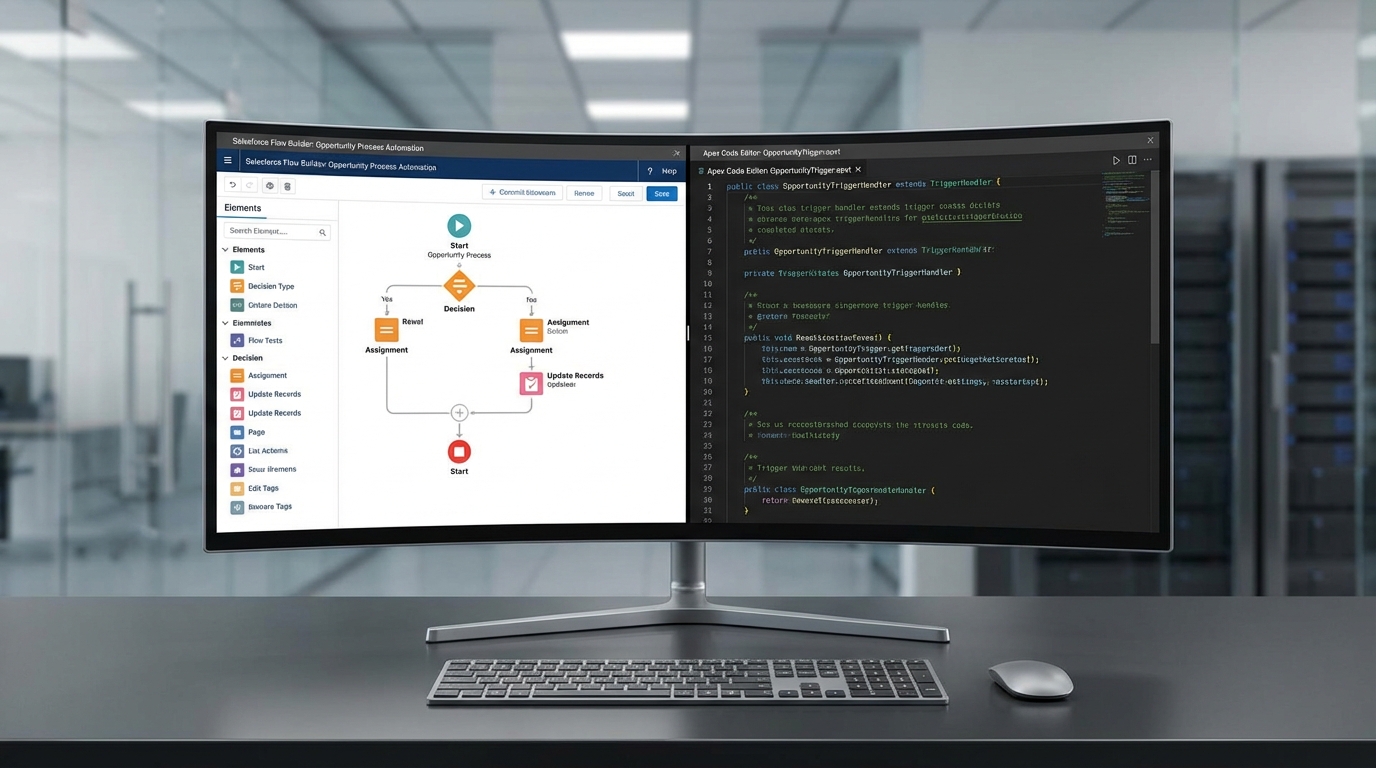
Apex Triggers and Design Patterns
When we talk about Apex, the conversation usually moves to triggers pretty fast. I’ve seen teams get really frustrated when a developer writes code that doesn’t scale. You need to know your trigger handler patterns. If you’re still putting all your logic inside the trigger file itself, it’s time to change that habit.
Recursion is another big one. If you’re asked how to prevent a trigger from firing itself in an infinite loop, you’ll likely talk about a static Boolean flag. It’s a classic answer, and it looks something like this:
public class TriggerHandler {
   public static Boolean isFirstRun = true;
}
Real-world insight: While a static Boolean works for simple cases, be ready to explain why it might fail in complex transactions involving partial saves or multiple batches. It shows you’ve actually dealt with messy production bugs before.
Database Efficiency and SOQL
Efficiency is the name of the game here. If you’re writing a query inside a loop, that’s an immediate red flag for any interviewer. But you probably already knew that. The more interesting Salesforce developer interview questions focus on things like the “FOR UPDATE” keyword for record locking or how to avoid SOQL injection by using bind variables.
You’ll also want to be comfortable with aggregate functions and how to handle large data volumes. If you can explain how to use indexed fields to keep your queries fast, you’re in a good spot. No one wants to hire a dev who builds a system that crawls once the org hits 100,000 records.
Lightning Web Components (LWC)
LWC is where most of the front-end questions live now. You’ll need to know the lifecycle hooks – like connectedCallback versus renderedCallback – and when to use them. But the real test is usually about communication patterns. How do you get two components to talk to each other? Is it through events, or are you using the Lightning Message Service?
Don’t forget about decorators. You should be able to explain @wire, @api, and @track without breaking a sweat. Most teams are looking for clean, modular code that follows modern JavaScript standards.
Why integrations are key in Salesforce developer interview questions
Almost every enterprise project involves some kind of integration. This is where things get interesting. You’ll likely be asked when to use REST versus SOAP, or how to handle a long-running callout that might hit the 10-second timeout limit. If the logic is too heavy to run in real-time, you should talk about your Async Apex types like Queueable or Batch Apex.
So, what’s the best way to prepare? Here’s what I tell my colleagues: don’t just read the answers. Try to build a small proof-of-concept for the things you’re less sure about. If you’ve never used a Named Credential or a Continuation in LWC, go build one. There’s no substitute for actually seeing the code run.
Key Takeaways
- Bulkify everything: This is non-negotiable in Apex and SOQL.
- Know the “Why”: Be ready to explain why you’d pick a Batch job over a Queueable one.
- Scenario-based thinking: Most Salesforce developer interview questions will start with “Imagine a client wants to…” so practice your storytelling.
- Test classes: Don’t just aim for 75 percent coverage. Talk about testing for bulk cases and negative scenarios.
At the end of the day, these questions are just a way for the team to see how you think. If you can show that you’re focused on building scalable, maintainable solutions, you’re going to do great. Use these 50 questions as a starting point, but let your actual project experience do the talking. You’ve got this.