

The Foundation of Your Data: Salesforce Report Types
Look, if you've spent any time in the Setup menu, you know that Salesforce report types are basically the foundation of everything your users see in their dashboards. If you get the report type wrong, it doesn't matter how good your filters are - the data just won't be there. I like to think of a report type as a template or a lens that sits over your database. It decides which objects, which records, and which specific fields are even allowed to show up in the report builder.
I've seen so many admins get frustrated because a field they just created isn't showing up in a report. Nine times out of ten, they're using a custom report type and forgot to add the new field to the layout. It's a classic "gotcha" that happens to the best of us. Let's break down how these work and how to choose the right one without overcomplicating your org.
Standard vs Custom Salesforce Report Types
Salesforce gives you a bunch of standard report types right out of the box. These are your bread-and-butter combinations like "Accounts with Contacts" or "Opportunities with Products." They're great because they're maintenance-free. If you add a new field to an object, Salesforce automatically tosses it into the standard report types for you. But they have a big downside: they're rigid. You can't change the "with" logic, and you can't pull in fields from distant related objects very easily.
Custom report types are where you get to be the architect. You decide the primary object and then chain up to three more objects underneath it. This is where you can finally build that "Accounts with or without Cases" report that your support manager has been asking for. But remember, with great power comes the chore of manual updates. When you add new fields to your objects, you'll have to manually drag them onto your custom report type layouts.
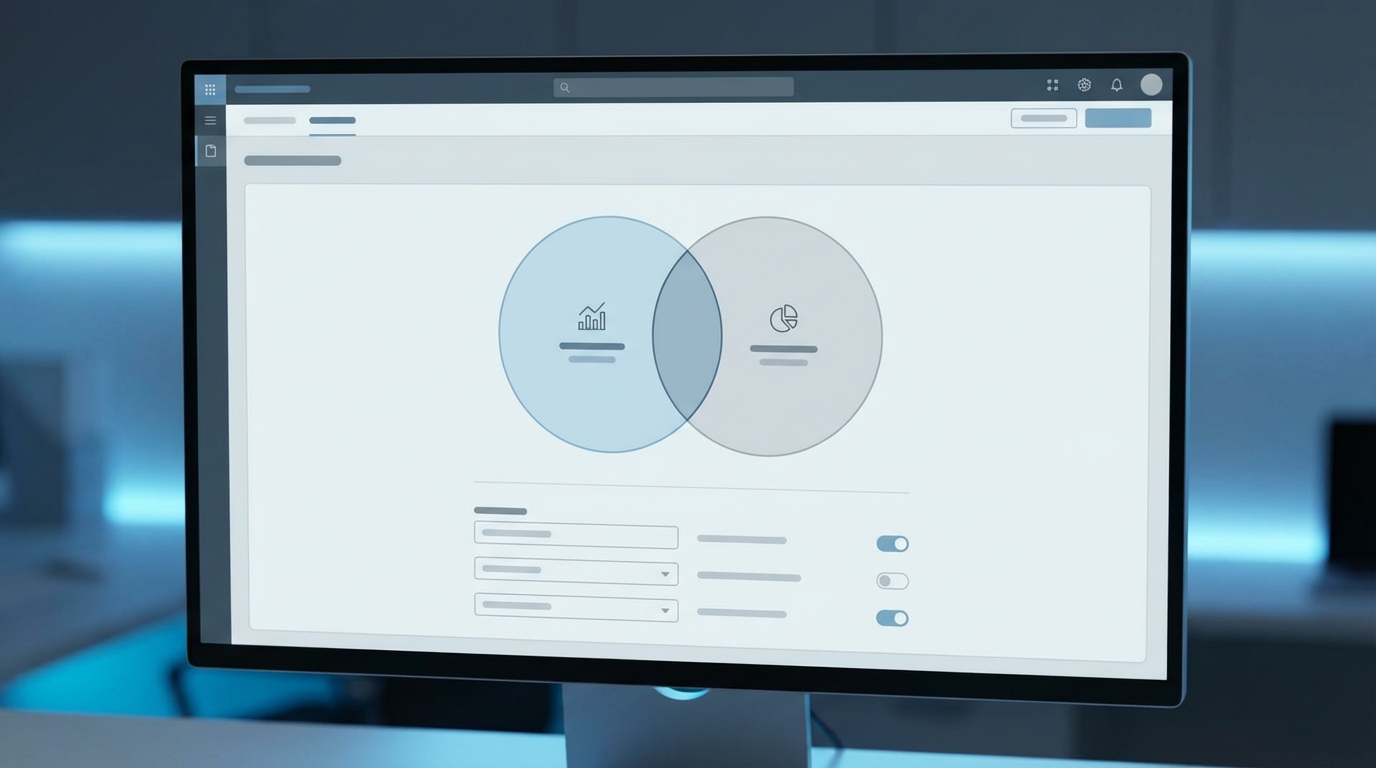
A realistic diagram of a software interface showing the configuration of a 'with or without' relationship between two data objects in a report builder.
The "With or Without" Logic
One thing that trips people up constantly is the relationship join. In a standard "Accounts with Contacts" report, an Account only shows up if it has at least one Contact. If an Account is "lonely" and has no Contacts, it's invisible to that report. That's an "inner join" for the SQL fans out there.
But what if you need to see a list of all Accounts, regardless of whether they have Contacts? That's when you need a custom version of Salesforce report types. You can set the relationship to "A records may or may not have related B records." Honestly, this is probably the most common reason I end up building custom types. It gives the business a much clearer picture of their data gaps.
Managing the Field Layout
Here's a tip from the trenches: don't just leave every single field on the layout. I've worked in orgs where the report builder was a nightmare because there were 500 fields to scroll through, half of them being old "Do Not Use" technical fields. When you build a custom report type, you can group fields into sections and rename them just for that report. It makes life so much easier for your end users.
Also, keep an eye on performance. If you're building complex reports on objects with millions of rows, the way you structure your joins matters. When you're dealing with massive amounts of data, you might want to check out this guide on managing Salesforce large data volumes to keep your org running fast.
The best report types are the ones users don't have to think about. If you find yourself explaining "just ignore those 50 fields at the bottom" to a stakeholder, it's time to go back into Setup and clean up your layout.
Best Practices for Salesforce Report Types
I've spent years cleaning up messy reporting environments, and I've found a few rules that keep things from spiraling out of control. First, start with a naming convention. If you create a custom type, call it something like "Accounts with Opportunities (Custom)" so you can tell it apart from the standard ones at a glance.
Second, don't over-nest your objects. You can go four levels deep (A > B > C > D), but every level you add makes the report slower and harder to understand. If you're trying to report on five different objects at once, you might actually be looking for a dashboard or a different data strategy entirely. So, keep it as lean as possible.
Key Takeaways
- Standard report types are low maintenance but have fixed "with" relationships.
- Custom report types allow "with or without" logic, which is essential for finding missing data.
- You must manually add new fields to custom report type layouts; they don't appear automatically.
- Limit your object chain to the essentials to keep report performance high.
- Use clear naming conventions so users know exactly what data they're looking at.
At the end of the day, Salesforce report types are all about making data accessible. Start with the standard types whenever you can because they're easier to manage long-term. But don't be afraid to jump into custom types when you need to control the field layout or the relationship logic. Just keep it clean, keep it fast, and your users will thank you.




Leave a Comment