
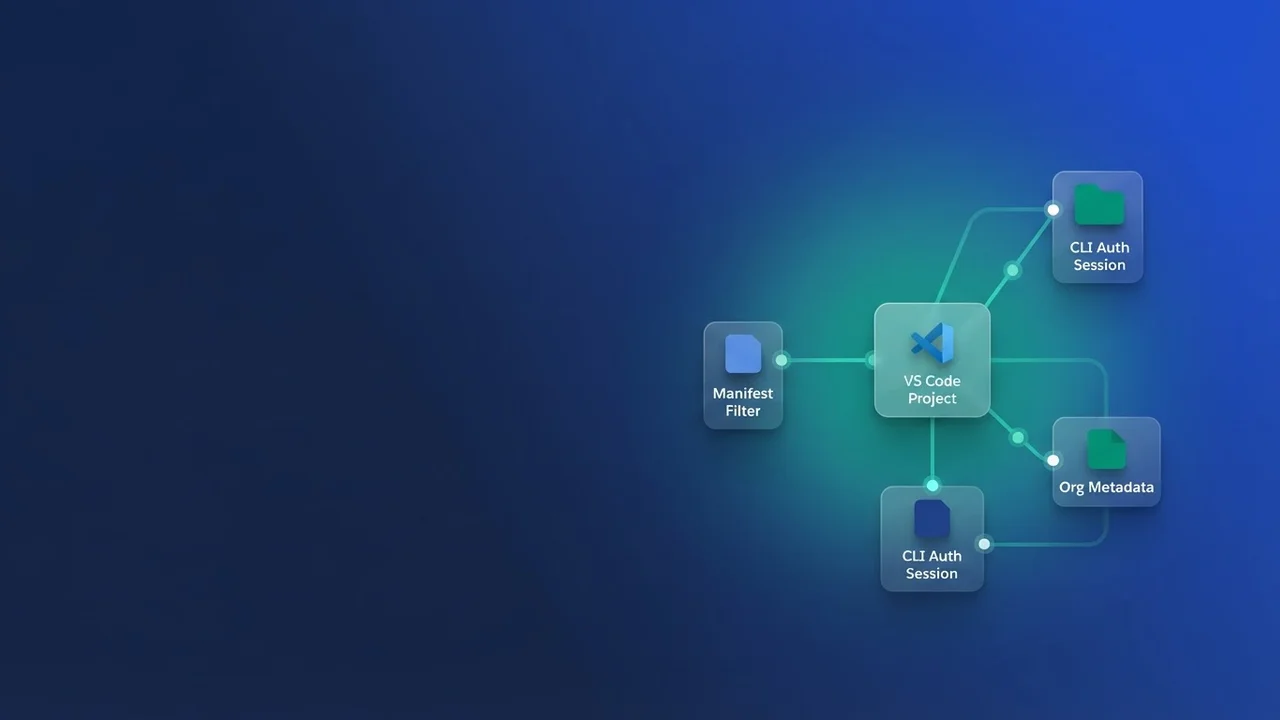

Resolving silent SFDX source retrieval failures in VS Code
The SFDX: Retrieve This Source from Org command fails or retrieves zero components when your metadata retrieval scope is undefined, your authorization session has expired, or your user lacks Metadata API permissions. You can resolve the issue in 4 steps by updating CLI tooling, re-authenticating your target org connection, defining component API names in package.xml, and confirming export permissions. Running the retrieve command directly in the terminal helps isolate whether the error is workspace-specific or tied to org access.
12:35:51.377 Starting SFDX: Retrieve This Source from Org
No components retrieved
12:35:51.396 Ended SFDX: Retrieve This Source from Org
A silent failure like this means the retrieval completed against the parameters it was given, and those parameters matched no deployable metadata in the target organization. The steps below work through the usual causes.
1. Verify Salesforce CLI and extension health
Start by confirming the core tooling is current and functional.
- Check the CLI version (
sf --versionorsfdx --versionin your terminal). Rolling back versions sometimes fixes transient issues, but stay on a currently supported version, as older versions might interact poorly with newer org APIs. - Update the Salesforce Extension Pack to the latest version available in the VS Code Marketplace. Stale extensions can lead to outdated API calls or communication issues.
2. Authentication state inspection
A common cause of zero retrieval is an expired or stale authorization session for the target org.
- Check active authorizations. Run the following command in your integrated terminal to list authorized orgs:
sfdx force:auth:list - Refresh the authorization. If the required org alias is listed, try refreshing the connection. The default VS Code command generally uses the currently authenticated user for the workspace, so consider forcing an authorization flow for the specific target org through the CLI:
Then point VS Code at this alias, or re-authenticate directly through the VS Code command palette (sfdx force:auth:web:login --setalias YourTargetAlias --instanceurl https://yourDomain.my.salesforce.comSFDX: Authorize an Org).
3. Metadata retrieval scope analysis
When retrieving, the system relies heavily on the scope defined by the execution context. With no scope explicitly provided (for example via package.xml or metadata type filtering), SFDX attempts to retrieve metadata based on the currently open folder structure or defaults, which may be empty or incorrect.
A. Retrieving via package.xml (recommended)
In a source-tracking project, or when retrieving specific components, the package.xml must accurately reflect what exists in the org.
- Validation: run a retrieval command manually in the CLI to isolate the issue from the VS Code UI:
If this command also returns zero components, the issue is in thesfdx force:source:retrieve -x -f path/to/your/package.xmlpackage.xmlcontent or the organization state, not VS Code. - Verify component names: the metadata types and component names listed in
package.xmlmust precisely match the names in the target org. API names, folder names (for things like Lightning Web Components or Reports), and suffixes must be exact.
B. Retrieving by component type (default behavior)
With the context menu (Right-click > SFDX: Retrieve Source in Current Org), the system infers the metadata scope. In a directory that does not map clearly to a metadata type, or where the component is not defined in the active project's package.xml (if present), retrieval may yield nothing.
- Context check: right-click a folder that contains metadata you expect to retrieve, such as the
classesfolder or the root of a component structure.
4. Permissions and visibility
Even when authenticated, the user context used for retrieval must have the permissions to view and export the specific metadata types.
- System permissions: check that the profile or permission sets assigned to the authenticated user include permissions like "View Setup and Configuration" and specific "Metadata API Level Access" for the component types being retrieved, such as ApexClass or CustomObject.
- License restrictions: check that the user license does not restrict access to features that might house the metadata you are seeking.
Key takeaways
Silent SFDX retrieval failures in VS Code almost always come down to scope definition or authentication state rather than a true command execution error. Test connectivity with sfdx force:auth:list, define the retrieval scope explicitly in a correctly formed package.xml, and confirm the user context has full export permissions for the targeted metadata structures.



Leave a Comment