

What does an Entry-level Salesforce Admin actually do?
Landing your first role as an Entry-level Salesforce Admin can feel a bit like being thrown into the deep end of a very expensive pool. I remember my first week on the job. I was terrified of clicking the wrong button and accidentally wiping out a decade of sales data. Most companies don't expect you to be an architect on day one, though. They need someone who can handle the day-to-day "plumbing" of the system.
In my experience, most Entry-level Salesforce Admin positions are focused on keeping the lights on. You'll spend a lot of time helping users who forgot their passwords, fixing messy data, and building basic reports. It's less about complex coding and more about making sure the sales team can actually do their jobs without the CRM getting in the way.
Common job titles you'll see
Don't limit your search to "Admin" on LinkedIn. The titles vary wildly depending on the company size. You might see roles like Junior Salesforce Administrator, Salesforce Support Specialist, or even Salesforce Data Analyst. If you are just starting out, you might even look for a free Salesforce course for beginners to get your feet wet before applying.
- Junior Admin: the standard entry point. You'll handle user access, page layouts, and simple automation.
- Support Specialist: the first line of defense. When a user says "I can't see this button," you're the one who figures out why.
- Data Analyst: heavy on reporting and on cleaning up the mess users leave behind in the database.
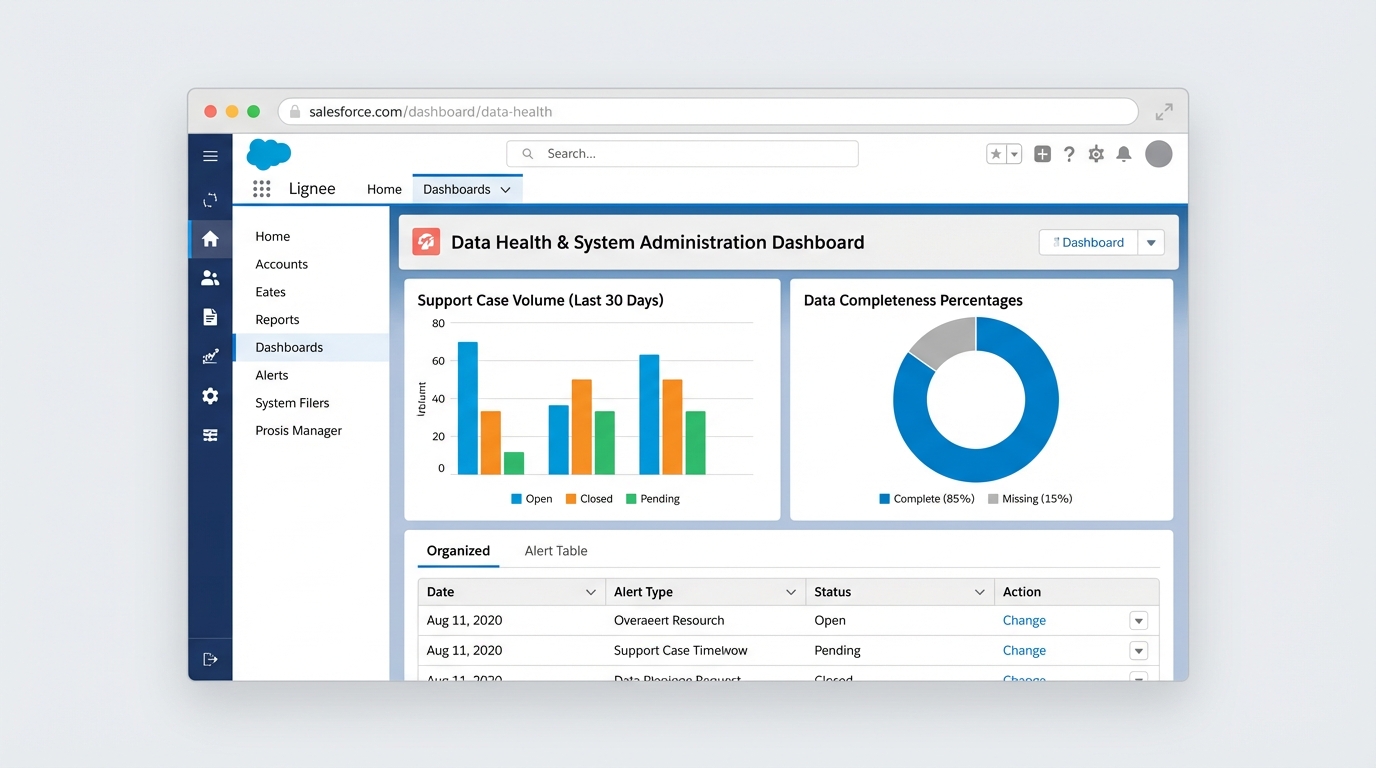
A Lightning dashboard tracking data quality and admin support metrics.
Practical steps to land an Entry-level Salesforce Admin role
So how do you actually get someone to hire you when you have zero years of experience? It's the classic "catch-22" of the job market. I've seen plenty of people break through by showing they can do the work. A certification is great, but it's the entry ticket. It doesn't prove you can solve a business problem.
One thing that trips people up is the lack of "real" projects. You don't need a corporate job to get experience. Spin up a free Developer Edition org and build something: a custom app to track your own job applications, or a system for a local non-profit. When you can show a recruiter a live org you built yourself, you're ahead of 90% of the other applicants.
I've interviewed dozens of candidates over the years. The ones I hire aren't always the ones with five certifications. They are the ones who can explain the "why" behind their work. If you can tell me why you chose a Flow instead of a Validation Rule, you've got my attention.
Mastering the interview basics
When you get that first interview, expect scenario-based questions. They'll ask things like, "A user can't see a specific record, how do you fix it?" This is where you need to know the difference between roles and profiles inside and out. If you stumble on the security model, it's a huge red flag for a hiring manager.
You should also be ready to talk about:
- Flow: the most important tool in your belt right now. You don't need to be an expert, but you should know how to build a basic record-triggered flow.
- Data hygiene: how you use Data Loader or Import Wizard. Companies care deeply about their data quality.
- User training: can you explain a complex feature to someone who hates technology? That is a massive part of the job.
How to grow once you're in the door
Once you've landed that Entry-level Salesforce Admin job, the real learning starts. Don't sit in your silo. Shadow the senior admins or the developers. Ask them why they built things a certain way. I've found that clarity is your biggest value-add as an admin. If you can document your processes and make the system easy to use, you'll become indispensable very quickly.
And don't stop at the Admin cert. Look into the Platform App Builder or the Data Architect paths. The more you understand how the data actually flows through the system, the more valuable you become to the business. The job is solving business problems with the tools you have.
Key takeaways: Entry-level Salesforce Admin
- Focus on business logic. Learn why businesses use the features you are clicking, beyond where the buttons live.
- Build a portfolio. Use a Dev Org to show off your work; it beats any resume bullet point.
- Network locally. Join a local Trailblazer community group, because most jobs are found through people rather than job boards.
- Master the security model. If you understand how users see and edit data, you've mastered 50% of the job.
The path to becoming a Salesforce professional isn't always a straight line. It takes a lot of Trailhead badges, a few failed Flow experiments, and a bit of luck. But if you focus on being a problem solver rather than a system configurator, you'll find that companies are desperate for good talent. Start building, keep learning, and don't be afraid to ask for help from the community. We've all been the "new person" at some point.



Leave a Comment